
[ Industry case study — AI & Automation ]
An AI proofreader to speed up appeal content at the Disasters Emergency Committee
Torchbox built an AI-assisted proofreading tool for the Disasters Emergency Committee, the umbrella body for 15 leading UK aid charities that must produce huge volumes of appeal content within hours. In a pilot based on a mock emergency, 100% of participants found the tool valuable and 64% said it helped them work more quickly.
Original project by Torchbox ↗Industry reference — not a NexSum Labs engagement.
- Client
- Disasters Emergency Committee
- Industry
- Charity & non-profit
- Services
- AI literacy and organisational readiness, Responsible AI governance, Use-case prioritisation, Custom AI tool build, Pilot facilitation and evaluation
- Year
- 2026
- Timeline
- 18 months
- Location
- United Kingdom
The client
The Disasters Emergency Committee brings together 15 leading UK aid charities to raise funds quickly and efficiently during humanitarian crises, and its emergency appeals typically launch within 24 hours of approval. Over the past 18 months Torchbox worked with the DEC on AI literacy, organisational readiness, governance, policies and responsible AI principles. The team then picked a first pilot that was practical, useful and low risk: an AI-assisted proofreader for appeal content, built and tested with a mock appeal scenario.
The challenge
An appeal launch puts press releases, emails, adverts, social content and supporter communications in production at the same time across several teams, and messaging can change rapidly as new information arrives. For an organisation operating in such a high-stakes environment, letting AI write appeal content unsupervised was not an option. The DEC needed a first use case with clear success criteria that could be tested safely while keeping human judgement at the centre of the process.
The solution
01Building confidence in AI first
Torchbox supported the DEC through AI literacy and organisational readiness work, an AI Fundamentals workshop exploring opportunities, risks and use cases, and the development of responsible AI principles. Teams were given space to experiment safely with existing tools before investing in anything bespoke.
02Prioritising proofreading as the pilot
Opportunities were assessed on their potential impact and alignment with organisational goals, their value for staff, how practical they would be to test, and the risks they could introduce. Proofreading was chosen because it addressed a real operational problem with clear success criteria and could be explored without risk to a live appeal.
03The Appeals Content Checker
The proofreader lets users select the channel, audience and copy type before submitting content for review. It factors in brand guidelines, appeal-specific guidance and best practice for that format, flagging deviation from approved messaging, outdated statistics, factual errors, confusing phrasing, incorrect terminology, spelling and grammar, and copy that breaks platform character limits.
04Keeping people in control
Users review every suggestion and decide whether to apply or ignore it. The tool was designed to support judgement rather than replace it, and the DEC's experienced teams still write the appeal content themselves.
05Testing with a mock emergency
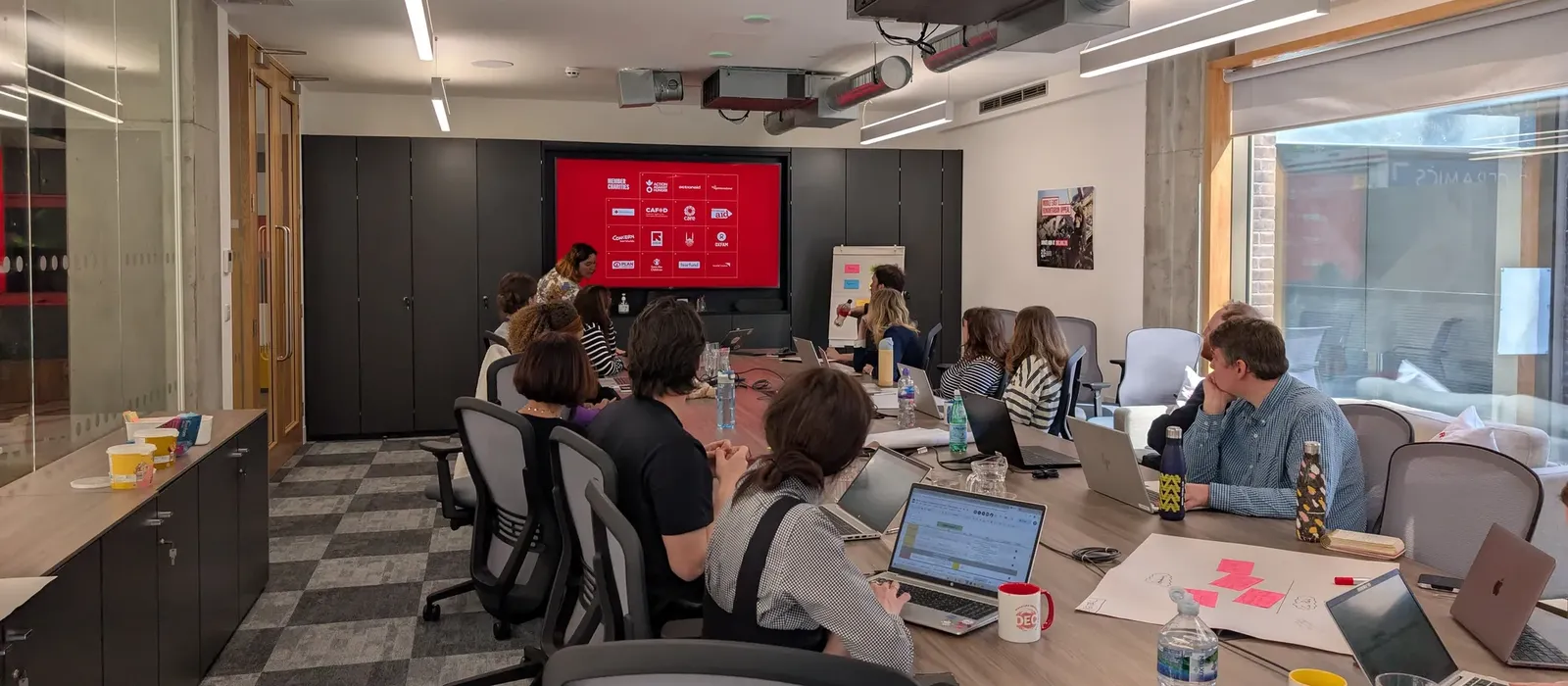
The DEC created a mock humanitarian emergency scenario based on a real-world situation, with colleagues from fundraising, communications, digital marketing, supporter services and partnerships producing content as they normally would. The exercise showed how the tool fitted existing workflows and gathered structured feedback without introducing risk into a live response.
The results
In the pilot, 100% of participants said they found the tool valuable, 73% said they would continue using it and 64% reported that it helped them work more quickly. Participants generally trusted the tool's suggestions but still applied their own judgement when reviewing content, which the DEC saw as the right balance. The DEC is using the feedback to prioritise future development, exploring how the same approach could support internal impact reports and policy documents, and revisiting the wider opportunities identified in the earlier AI Fundamentals workshops.
Original project by Torchbox ↗ — published by the delivering agency, included here as an industry reference.
[ More industry examples ]
More from ai & automation.
 AI & Automation
ARC Europe · 2026
LLM chatbot routes stranded drivers in 2-4 questions
2-4questions to reach the right service
 AI & Automation
Mattioli Woods · 2026
Automated reconciliation saves 14,000+ staff hours a year
14,000+staff hours saved annually
 AI & Automation
Merck · 2024
AI assistant cuts compound research from months to hours
6 hoursto find molecules, vs. 6 months manually
[ Next step ]
Want this kind of result? Let's scope it.
contact@nexsumlabs.tech — we reply within one business dayNext case study — The Couture Club